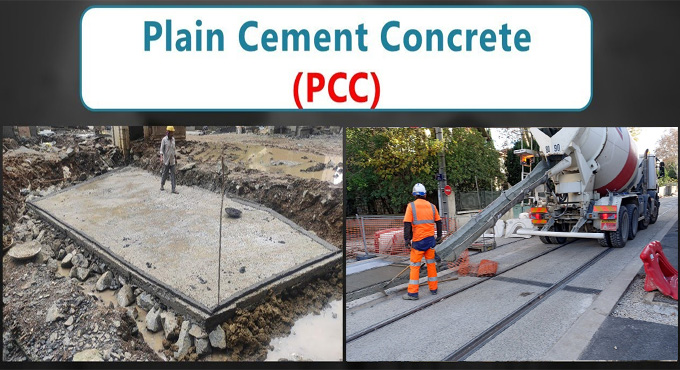

Using Plain Cement Concrete (PCC) in the Footing Works
The plain cement concrete (PCC) is obtained by hardening the sand, cement, gravel and water mixture in predetermined proportions. PCC refers to the first layer of concrete that has been laid directly on the soil before starting the main foundation work of the building construction project.
The PCC helps to create a flat and strong base; as a result, the foundation of the building structure has been built properly. The proportion of the cement, sand, and stones in the PCC is generally about 1:4:8 or 1:3:6. The thickness of the PCC has ranged between 3 and 6 inches, on the basis of the soil condition and the building types. The PCC plays an important role in making the foundation structure of the building stronger and more long-term durable.
Discuss the materials used in the PCC
Cement
Cement has been used in the PCC as the binding material. In PCC, generally, Ordinary Portland Cement (OPC) or Portland Pozzolana Cement (PPC) has been used.
Sand
The sand used in the PCC should be clean river sand, and it should be free from clay or organic impurities. The sand used in the PCC should also be properly graded.
Coarse aggregate
In PCC, the size of the coarse aggregate should be between 20 mm and 40 mm. In this context, the coarse aggregate needs to be hard, durable, clean and also should be free from dust.
Water
Water used in the PCC should be clean and potable. Clean and potable water in PCC is important as dirty water can reduce the overall strength of the concrete.
Learn about the reasons behind laying PCC before the footing works in the construction project
Providing a clean base for footing
The PCC helps to create a hard, flat and uniform platform for the footing in which the placement of reinforcement or shuttering has been done. This layer helps to ensure that the dimensions of the footing will match its structural drawings.
Maintaining concrete cover
In the case where reinforcement has been placed directly on the soil, the concrete cover becomes inconsistent; the steel of the reinforcement bars can touch the soil, which leads to the attack of moisture and chemicals on the reinforcement bars. In this context, the use of a PCC layer on the footing helps to ensure that the reinforcement bars remain stable and the correct concrete cover has been achieved throughout the footing.
Preventing soil contamination with concrete
In the case of a structural concrete mix with mud or loose soil, the bonding at the bottom of the concrete becomes weakened, and the footing strength of the building is reduced.
Creating a stable platform
The PCC layer in the footing helps to provide a firm surface, which helps to support the shuttering and reinforcement cages without any kind of movement during the concreting process.
Reducing water loss from concrete
If the footing concrete has been poured on the soil directly, the soil can draw water from the mix as it absorbs water quickly. The PCC layer in the footing helps to prevent water absorption, which allows the structural concrete of the footing to set under controlled moisture conditions.
Involved in load distribution
The PCC layer on the footing also helps to distribute the construction load more efficiently and uniformly, which helps to prevent any kind of distortion and settlement.
Protecting the footing from rainwater
In rainy conditions, the excavated pits are prone to softening of the soil, formation of mud at the construction site and puddle water. In this context, a PCC layer helps to seal the footing base; as a result, the footing can be cast safely without any kind of contamination when water enters the pit.
Acting as a template for footing dimensions
The PCC layer has been used in the footing for accurate alignment of the formwork and accurate positioning of the rebars.
Improving construction site safety
A stable layer of PCC on the footing allows the construction workers to move safely on the construction site. Without PCC on the footing, there is a risk of slipping on the loose soil, and the settlement of the formwork becomes difficult.
Preventing contact with chemicals
The PCC layer on the footing acts as the protective layer, which helps to reduce any kind of chemical interactions between the structural footing and soil.
Makes the dewatering process easy
The PCC layer helps to prevent the base of the footing from turning muddy, and it helps to remove water easily from the base without disturbing the soil, thus helping to ensure that the footing can work more smoothly.