
Flight of Stairs: Types, Number of steps and Uses
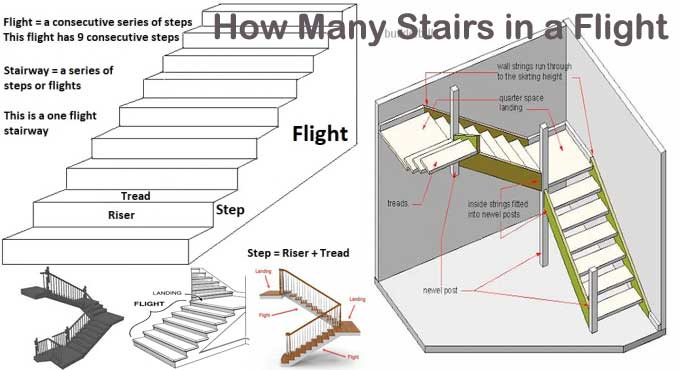
The flight of stairs has been composed of a series of steps that have been arranged between the floors or landings. The flight of stairs is the essential feature of any multi-story building structure, which serves as the primary means of vertical transportation and helps to meet the strict safety regulations of the building design.
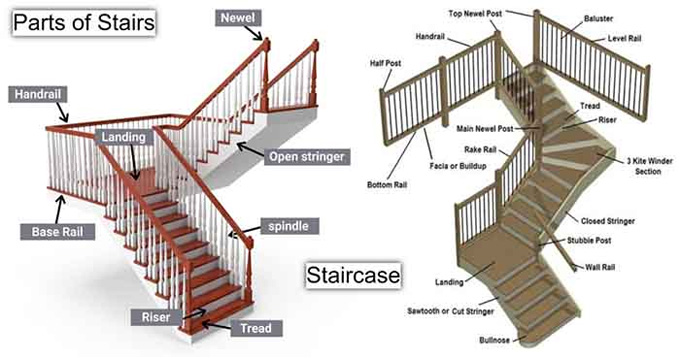
The flight of stairs helps to ensure the safe passage for individuals of all ages and physical abilities.
Discuss the different types of flight of stairs
Different types of flight of stairs have been constructed, which have individual, unique design features. These flights of stairs can also be customised to fit different architectural styles and the functional requirements of the building structure. The most common types of flight of stairs are as follows:
Straight staircase
The straight staircase consists of a single straight flight of stairs ot two separate flights connected by landings. The straight staircase lacks the privacy barrier that has been provided by other types of stairs.
Quarter-turn or L-shaped staircase
This type of stair flight consists of two straight stairs that have been attached by a 90° turn, with each step turning at a 90° angle. This design helps to create an L-shape and thus adds visual interest to a building structure. This type of staircase also has space-saving qualities, which makes it a popular choice for those looking to create a smart and efficient home.
Half-turn or U-shaped staircase
This type of stair flight consists of two straight flights with two 90° turns, which helps to make the steps turn 180° from base to top, and thus can provide greater safety and comfort.
Spiral staircase
The spiral staircase features treads winding around a central pillar or shaft, which helps to give a distinctive spiral, helical, screw, corkscrew, or cockle shape.
Helical staircase
This type of staircase features treads, which rotate from their base in elliptical, circular, or polygonal shapes, thus helping to create a unique architectural element in any space. The helical staircase also has narrower treads and passageways, which offer space-saving qualities.
Learn about the number of steps in a flight of stairs
The number of steps in the flight of stairs can vary on the basis of different factors, including the building code requirements, height of the floors being connected and also the purpose of the stairs. The number of steps in the flight of stairs is generally between 10 and 20.
To calculate the number of steps in a flight of stairs, several steps need to be followed, which are:
Measuring the heights between the floors
The vertical distance between the top of the finished floor at the upper level and the top of the finished floor at the lower level needs to be measured to determine the total rise of the stairs.
Measuring the height of each step
The desired height of each step needs to be decided. On the basis of the building codes, the maximum height should be 7.75 inches per step. In this context, the total rise should be divided by the desired height of each step, which helps to get the number of steps.
Making adjustments for landings
Building code requires landings at the top and bottom of each flight of stairs in cases where the stairs are longer than a certain distance. In this case, the number of steps needs to be adjusted to account for the landings.
Checking the building code requirements
The local building codes also need to be checked to make sure that the number of steps and other dimensions comply with the building regulations.
Understanding the benefits of flight of stairs
The flight of stairs offers several advantages, which are as follows:
Providing exercise
The flight of stairs helps to provide a quick and easy way to get exercise, as climbing stairs helps to improve cardiovascular health, burn calories and build muscle strength.
Space-saving feature
The flight of stairs can take up less space than a ramp, which helps to make a practical and efficient way to connect the floors in the building structure.
Offering convenience
The flight of stairs also helps to provide a reliable and convenient means of vertical transportation, which can be used at any time.
Increasing accessibility
The building code has been required as the stairs have been designed to be accessible to people with disabilities. The flight of stairs has been equipped with several features, for example, wider treads, handrails, and shorter risers, which make it easy to use for people with mobility impairments.
Visually appealing design
Well-designed flight of stairs helps to provide an attractive architectural feature to the building structure.
To learn more, watch the following video tutorial.
Video Source: The Civil Bro - Civil Structural Design
Promoting social interaction
The flight of stairs also acts as a meeting place or social gathering spot, which helps to encourage people to pause and chat when they pass by each other on the stairs.