
Guide on Admixtures in Concrete: Types and their Uses
The concrete admixtures help to improve the strength, resilience and adaptability of the concrete used in the construction work. Using the right admixtures and ensuring the quality of the concrete helps to boost the overall strength of the concrete; thus, the concrete admixtures help to improve the durability and workability of the construction structure in any environmental conditions.
The selection of the right types of admixtures is important to improve the overall performance of the concrete and meet specific project requirements. The right type of concrete admixture also helps to reduce the overall costs of the construction project, as well as ensures the quality of the construction work. Thus, the right admixture helps to achieve the desired structural characteristics and long-term resilience of the concrete structure.
Discuss the different types of admixtures used in construction projects
Chemical admixtures
SuperPlasticizers
This chemical admixture is one of the most effective admixtures, which helps to improve the strength, flowability and durability of the concrete. The addition of SuperPlasticizers helps to reduce the water content of the concrete without losing workability.
Plasticizers
This type of chemical admixture helps to improve the workability of the concrete by enabling better flow along with less water. The addition of Plasticisers to the concrete helps to enhance concrete’s workability.
Set Retarders
This chemical admixture helps to speed up the setting time of the concrete. This chemical admixture has been used in cases where the concrete needs to be transported over long distances.
Accelerators
This chemical admixture also helps to speed up the setting and hardening process of the concrete. The hydration rate in hydraulic cement has also been increased by using accelerators, which improves the overall strength of the concrete.
Mineral admixtures
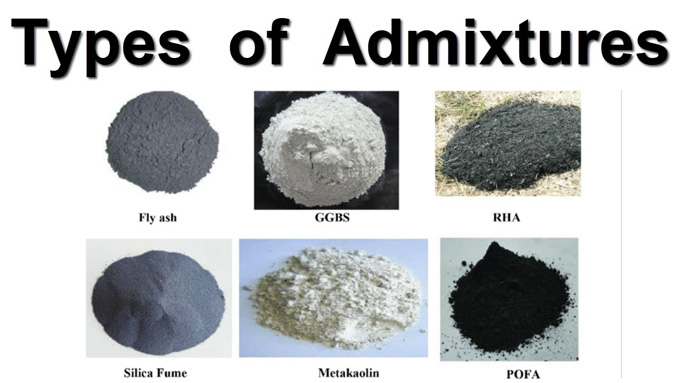
Mineral admixtures has been used in the concrete that has been widely used to enhance the overall durability of the concrete. The mineral admixtures are as follows:
Cementitious
This type of mineral admixture has been used with ordinary Portland cement or pozzolanic materials, which helps to achieve durable concrete structures.
Pozzolanic
This mineral admixture helps to exhibit cementitious properties when mixed with calcium hydroxide.
Fly Ash
Fly ash is the fine residue that has been generated by the combustion of ground or powdered coal. This type of mineral admixture helps to reduce the concrete heat of hydration and helps to improve the durability of the concrete.
Rice Husk
This type of mineral admixture helps to improve the performance of the self-compacting high-performance concrete. A high level of silica has been used in the rice husk, which helps to improve the impermeability, strength, workability and resistance of the concrete to corrosion.
Silica Fume
This mineral admixture improves the concrete resistance to the surrounding atmosphere and also helps to protect steel from corrosion.
Learn about the applications of concrete admixtures in construction projects
➢ The admixtures help to improve the workability of the concrete in a construction structure.
➢ Admixtures also help to improve the overall durability of the concrete by entrainment of air.
➢ The water requirements of the concrete have been reduced by using the admixtures in the concrete.
➢ The addition of the admixtures in the concrete helps to produce high early strength.
➢ The admixtures also help to reduce chemical reactions and heat evolution in the concrete.
➢ Using admixtures in the concrete helps to accelerate the setting time of the concrete.
➢ The bond between the existing and new concrete can also be improved by adding admixtures to the concrete.
➢ The rate of slump loss has also been decreased by adding admixtures to the concrete.
Which factors influence the performance of the concrete admixtures?
Type of cement
Different types of cement produce different results along with different admixtures. The concrete performance has been also detetrmined by the compatibility between the cement and admixture.
Type of admixture
Different types of admixtures have been designed to improve the setting time of the concrete, strength and durability of the concrete. Each type of admixture comprises different physical and chemical properties, which affect the performance of the concrete.
Dosage of admixture
The functionality of the cement can be influenced by adding excess or insufficient admixtures into the concrete.
Temperature of ambient
The performance of the admixture has been based on the temperature of the surrounding environment. In the case of the surrounding temperature increasing, the saturation dosage has also been increased, which significantly influences the effectiveness of the concrete.
The mix
The mixture of the concrete influences the final performance of the concrete. In this context, fine aggregates, coarse aggregates and cement addition in the concrete significantly influence the physical interaction and efficiency of the admixtures.